
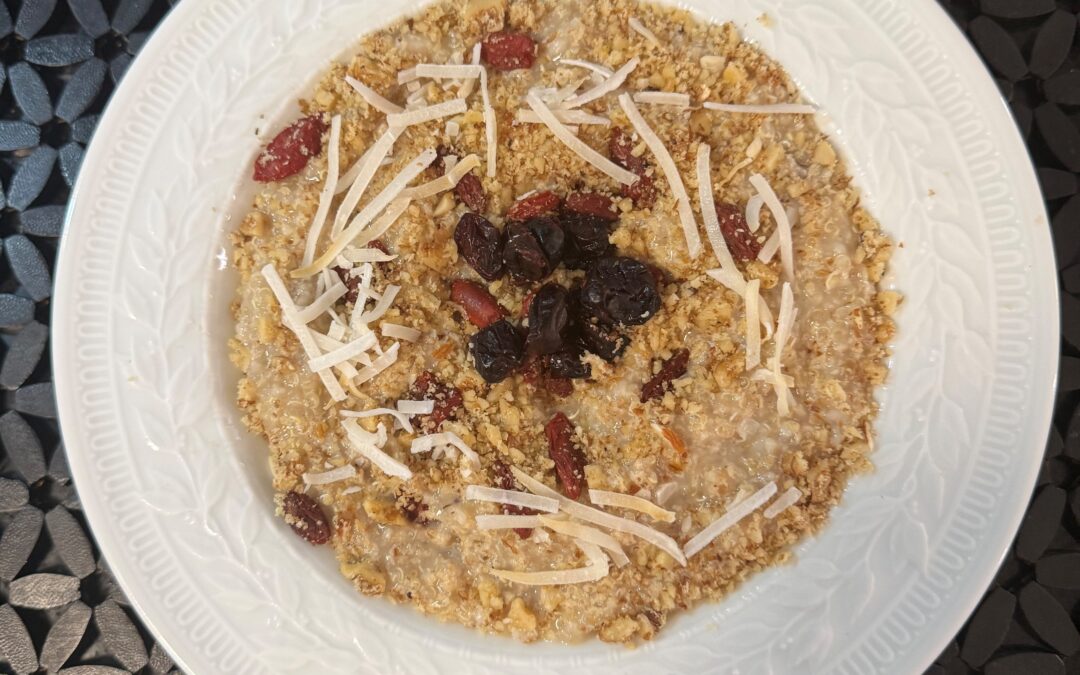
Breakfast for the Hungry Senior Belly: Steel Cut Oats & Quinoa
I’m a fan of eating oats for breakfast at least once week, as long as I add goodies to enhance the flavor and fill my belly! I love breakfast and find I need to eat lots of food with protein or I’m starving hours later. That’s just me, everyone is different. I have a jar in the fridge where I mix the steel cut oats with quinoa because it fills me up and the stats show it’s healthy. I’m not going to measure therefore, I have it pre-mixed. Easy, right! My goodies are nuts, coconut ,cranberries, goji berries and whatever other yummy dried fruits or fresh fruits I have around. Bananas and blueberries rock! Most of the time I add pure vanilla extract, this is something I also make for a hobby. I also chop nuts in the food processor and I also always have a jar in the fridge to just pour on top of the breakfast, or on my daily yogurt. Quick easy and healthy for me!
You need to eat what your doctor tells you is right. I’m not a doctor nor am I a nutritionist so don’t follow what I do! Do what the professionals advise you to do.
 What Are Steel-Cut Oats?
- Steel-cut oats are the inner kernels of whole oats that have been cut down into 2 or 3 pieces using a steel blade. You might also hear them referred to as Irish oatmeal.
- Steel-cut oats are chewy and have a slightly nutty flavor. They can be used in place of other types of oats in just about any recipe, or as a satisfying, fiber-rich breakfast option.
Steel-cut oats vs. old-fashioned oats
- Steel-cut oats and old-fashioned oats, also known as rolled oats, are both oat kernels, but they’re processed differently. Steel-cut oats are cut into pieces while old-fashioned oats are steamed and rolled flat, which makes them cook faster.
- Steel-cut oats take 15 to 20 minutes longer to cook than old-fashioned oats and require more water for cooking. They contain similar types and amounts of nutrients, but steel-cut oats have slightly more fiber.
- Steel-cut oats also take longer to digest. This helps you stay full longer and doesn’t cause as much of a rise in your blood sugar. https://www.webmd.com/diet/health-benefits-steel-cut-oats
- Quinoa (pronounced ”KEEN-wah”) is a small, round seed that people in South America have eaten for thousands of years. Today, this food has become a staple grain in the U.S. and other Western countries.
- And there’s a reason why quinoa has caught on: It’s loaded with health benefits. Registered dietitian Beth Czerwony, RD, LD, shares why quinoa deserves a place on your plate.
Reference: https://www.webmd.com/diet/health-benefits-steel-cut-oats
Quinoa’s health benefits
Reference: https://health.clevelandclinic.org/quinoa-benefits
The many nutrients in quinoa can boost your health. Including it as part of an overall healthy diet can:
 1. Boost your digestive health
Most Americans don’t get the recommended amount of dietary fiber, which keeps your digestion running smoothly. Fortunately, quinoa is a tasty way to boost your fiber intake. More fiber in your diet can help reduce constipation and bloating.
“On average, adults should be getting 25 to 35 grams of fiber each day,” says Czerwony. “Using quinoa in place of lower fiber choices like white rice or processed grains could help you have a healthier gut.”
2. Cut your colon cancer risk
The benefits of fiber go beyond better bathroom habits. A high-fiber diet also reduces your risk of colorectal cancer, the second-leading cause of cancer-related deaths in U.S. adults.
“Research shows that people who eat the highest amounts of fiber have a lower risk of colon cancer,” notes Czerwony. “Fiber moves food waste through your colon more quickly. Then, harmful substances that could lead to cell damage don’t have a chance to take hold.”
3. Help control your hunger
It’s hard to lose weight when you feel hungry all the time. But foods with plenty of protein and fiber take longer to digest so you feel fuller, longer. And quinoa isn’t only loaded with fiber, but it’s a complete protein, too.
A complete protein is a food that contains all nine essential amino acids. Amino acids are the building blocks of protein, and you need them for everything from building muscle to keeping your immune system healthy. Your body makes some amino acids, but you must get the “essential” nine from your diet.
“Quinoa is one of the few plant foods that contain all nine essential amino acids,” shares Czerwony. “Most complete proteins are meat, so eating quinoa helps you get your protein without the possible health risks of meat. It’s a great protein option for vegans and vegetarians — and omnivores, too.”
4. Lower your risk of diabetes
Quinoa is a good source of magnesium — an important mineral that many people don’t get enough of. And people with higher amounts of magnesium in their diets may have a lower risk of developing Type 2 diabetes.
Reference: https://health.clevelandclinic.org/quinoa-benefits